
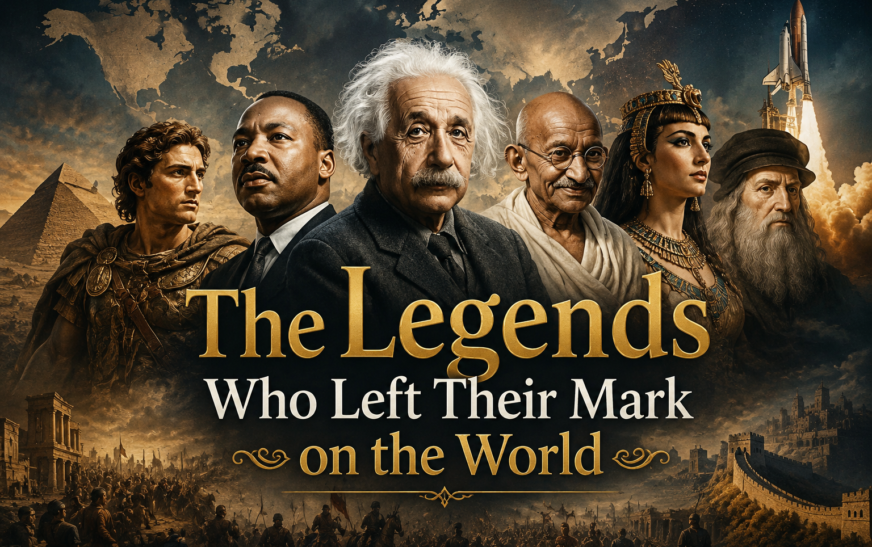
When I was around twelve, my history teacher asked our class to name someone who changed the world. Every hand shot up. We said the usual names. Einstein. Gandhi. Martin Luther King. She wrote them on the board, nodded, then asked something nobody expected: “What were they doing at thirty that nobody noticed yet?”
Complete silence.
Nobody knew. Because nobody had ever taught us that part. We got the speeches and the Nobel Prizes and the statues. We never got the years before any of that, when these same people were broke, ignored, doubted, sometimes imprisoned, sometimes laughed at, still doing the work anyway.
That gap between the legend and the actual person is what I keep coming back to. Because the legend version is basically useless. It’s inspiring in the way that watching Olympic gymnastics is inspiring, which is to say, it makes you feel like you’re watching a different species doing something that doesn’t apply to your life.
The real version is different. And a lot more interesting.
The Part of History Nobody Teaches You
Pick any person we now consider a legend and go looking for what their life looked like in the middle. Not at the peak. Not at the famous moment. The middle, when they were still figuring things out, still failing regularly, still unknown to most of the world.
What you find almost every time is a long stretch of ordinary persistence dressed up as nothing remarkable. Lincoln losing elections for years and going broke and having what sounds in historical accounts a lot like severe depression. Van Gogh painting obsessively for a decade while selling almost nothing and relying on his brother to pay his bills. Harriet Tubman suffering from narcoleptic episodes her entire life, a condition caused by a head injury she received as a slave, and conducting missions through the Underground Railroad anyway.
The legend smooths all of this out. You get the highlight, compressed into a paragraph, and then the transformation, and then the triumph. What gets cut is everything that made the triumph mean something.
Why the Cleaned-Up Version Actually Hurts Us
There’s a particular kind of discouragement that comes from reading about extraordinary people the way history usually presents them. It doesn’t make you feel inspired so much as it makes you feel like you missed something. Like the gap between you and them is so fundamental and constitutional that effort alone couldn’t close it.
That feeling is a product of bad storytelling, not historical fact. The people we call legends were not operating from some different emotional register than the rest of us. They got tired. They doubted. Several of them were deeply unpleasant to be around in specific ways that their biographies try to handle delicately.
Getting to the actual person underneath the legend turns out to be both more humbling and more useful. Because what you usually find is someone making decisions, not someone receiving gifts from fate.
Nelson Mandela and Twenty-Seven Years of Patience
Most people know the headline version of Mandela. Prison. Release. President. Nobel Prize.
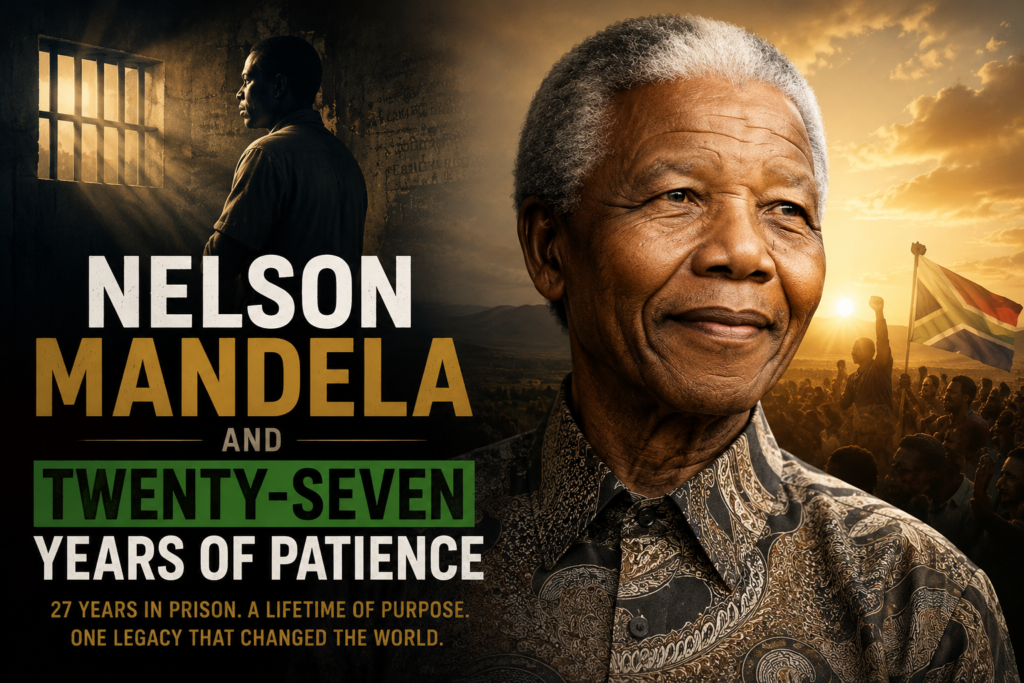
Fewer people know that the man who walked out of Victor Verster Prison in 1990 was meaningfully different from the man who walked in twenty-seven years earlier. And that the difference wasn’t just age.
Young Mandela was sharp, confrontational, and had committed to armed resistance. Together with others, he helped form Umkhonto we Sizwe, the ANC’s military wing, after concluding that peaceful protest alone was not going to move the apartheid government. A life sentence followed in 1964, handed down partly on the basis of his own willingness to acknowledge that strategy openly in court. He did not apologize for it.
What Robben Island did to him over the following decades is genuinely hard to categorize. It didn’t break him, which was presumably the intention. It also didn’t simply harden him. Something more complicated happened. Books became his constant companions. Endless debates with other political prisoners sharpened his thinking in ways no university could have. Teaching fellow inmates gave him purpose. Gradually, a view of South Africa’s future took shape inside him, one expansive enough to include the people who had imprisoned him, not out of naivety but out of a specific strategic understanding that revenge and national survival were incompatible goals.
The Decision That Took More Courage Than Any Weapon
When Mandela became president in 1994, the expectation in many circles was bloodshed. Decades of systematic brutality had produced an ocean of legitimate fury. The white minority that had run the apartheid system was terrified of exactly what you’d expect them to be terrified of.
Mandela’s response to this was the Truth and Reconciliation Commission, chaired by Archbishop Desmond Tutu. The premise was blunt and deeply uncomfortable: perpetrators of apartheid-era crimes could receive amnesty in exchange for full public confession of what they had done. Victims had to sit in the same rooms as the people who had destroyed their families and listen to detailed accounts.
Nobody pretended this was fair. It wasn’t designed to be fair in a personal sense. It was designed to allow a country to look at what had happened without the process of looking tearing it apart.
People still argue about whether it worked. South Africa’s history since 1994 is complicated and not a simple success story. But the TRC itself was a thing that nobody had done before at that scale. The decision to prioritize the country’s ability to function over the satisfaction of punishment came from a man who had personally spent twenty-seven years paying the price of someone else’s cruelty. That context matters enormously.
Marie Curie and the Shed That Changed Science
There’s a detail about Marie Curie that I find myself thinking about more than the Nobel Prizes.
Her notebooks from the 1890s, the ones she used while isolating radium and polonium, are stored in lead-lined boxes at the Bibliotheque Nationale in France. They’re still radioactive. They’ll be radioactive for another fifteen hundred years, give or take. Researchers who want to examine them physically have to sign a legal waiver acknowledging the radiation risk.
The woman whose hands touched those notebooks had no idea. The concept of radiation safety didn’t exist because the concept of radiation was something she and Pierre were in the process of defining. She carried test tubes of radioactive isotopes in her pockets. She kept samples on her bedside table because she liked the faint glow they gave off in the dark. Her health declined for decades as a direct result, and she died of aplastic anaemia in 1934, almost certainly caused by cumulative radiation exposure.
She won the Nobel Prize in Physics in 1903 and the Nobel Prize in Chemistry in 1911. Nobody else has won in two different sciences. Nobody.
What Her Actual Working Conditions Looked Like
The laboratory where she and Pierre did the work that led to the first Nobel wasn’t really a laboratory. It was a leaky shed with a dirt floor and no proper ventilation. The process of isolating radium required processing literal tonnes of pitchblende ore, which meant lifting, stirring, and hauling enormous amounts of heavy material in conditions that were physically brutal.
She had been denied entry to the University of Warsaw because it didn’t accept women. She’d attended an illegal underground university in Poland. She moved to Paris with almost no money, studied while sometimes being too cold and too hungry to concentrate properly, and eventually secured lab access and research opportunities through sheer persistent excellence that made her impossible to ignore.
What strikes me about Curie is something my history teacher’s question was actually pointing at. At thirty, she was a struggling student in Paris that nobody outside her immediate circle had heard of. The work that would define the twentieth century’s understanding of atomic physics was still years away. She was cold and underfunded and working in a field that had decided women weren’t really meant to be there.
She just kept going. That’s not a small thing to say. It’s actually the whole thing.
Frederick Douglass and Teaching Himself to Read With Bread
Frederick Douglass was born into slavery in Maryland around 1818. He never knew his actual birth date. That wasn’t an oversight. It was policy. Keeping enslaved people ignorant of basic facts about themselves including when they were born was a deliberate mechanism of control.
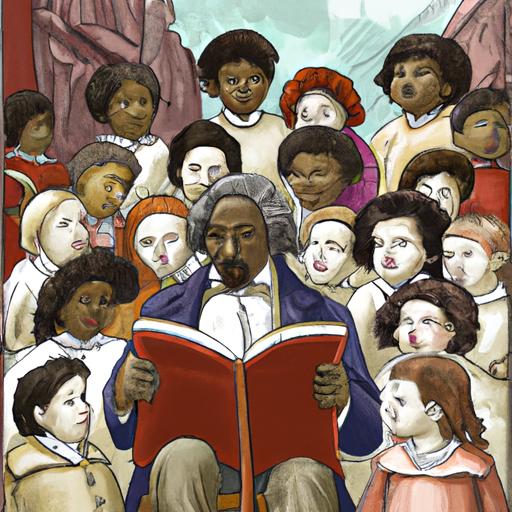
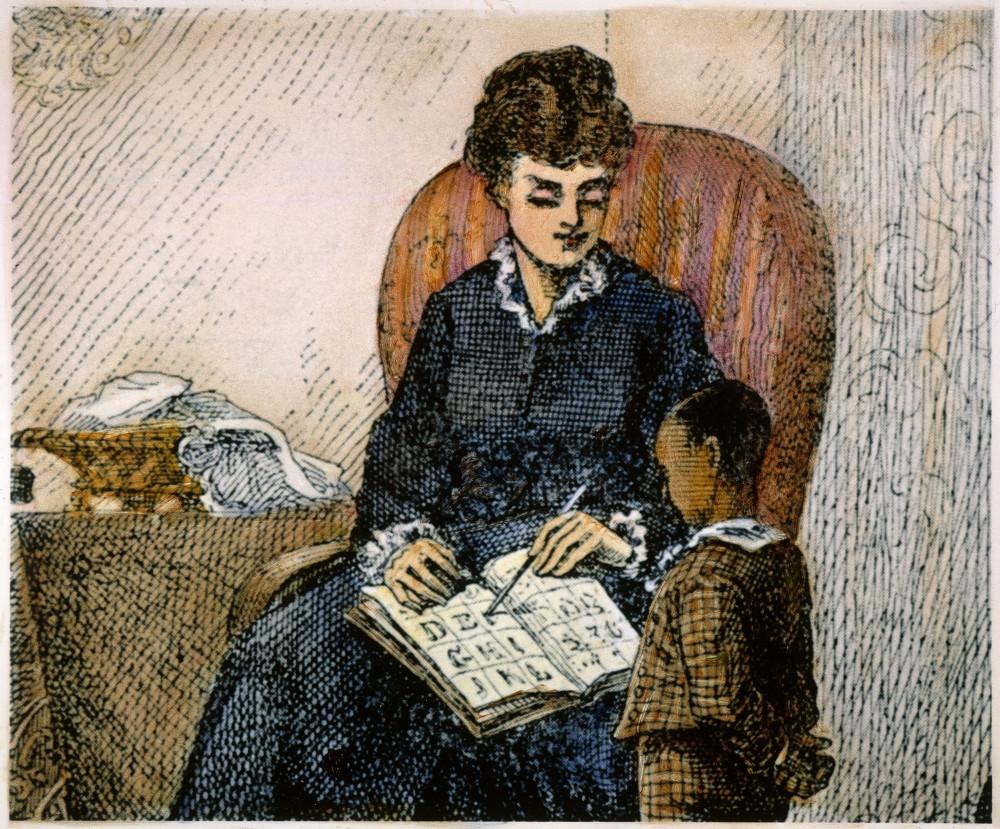
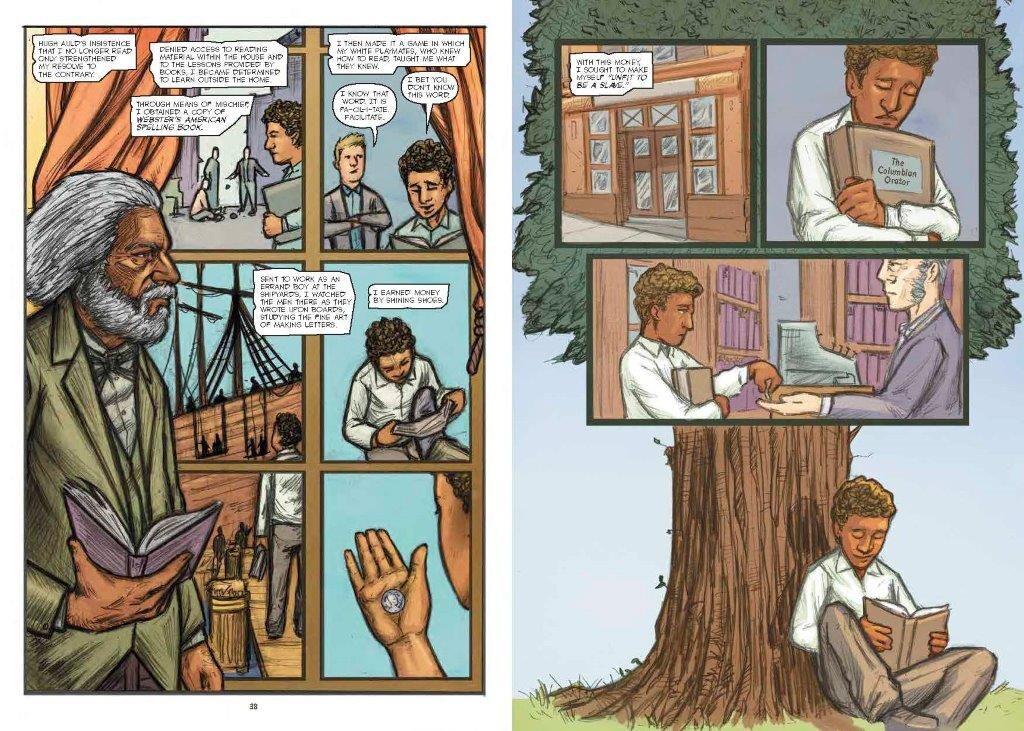
He learned to read as a child by trading pieces of bread to white children in the neighborhood in exchange for reading lessons. This was illegal. Teaching an enslaved person to read was a criminal offense in Maryland. He did it anyway, in secret, because he had figured out at around eight years old that literacy was the thing that separated him from freedom, conceptually if not yet physically.
At twenty, he escaped north. Over the following decades, Douglass became one of the most powerful writers and speakers of the nineteenth century. A direct line ran from that illegal shed classroom to the White House, where he advised Abraham Lincoln during the Civil War. His autobiographies are still in print and still read, not as historical curiosities but as literature.
Why He Published His Own Story Knowing the Risk
In 1845, Douglass published his first autobiography. His former slaveholder was named in it. The plantation was named. Specific geographic details made him entirely locatable to anyone who wanted to find him.
The risk was fully understood. His slaveholder could now find him. Legal freedom didn’t exist yet for Douglass at that point. Publishing that book was an act of deliberate, calculated courage that put him in genuine physical danger.
The reason he did it was strategic as much as personal. Pro-slavery arguments in the 1840s frequently rested on the claim that enslaved people were intellectually incapable of complex thought, that they were content with their circumstances, that the institution was somehow mutually beneficial. Douglass’s book dismantled every one of those claims simply by existing. The prose was too controlled, too intelligent, too precise for the standard arguments to survive contact with it.
He had to flee to Britain for two years after publication. Friends eventually raised enough money to purchase his legal freedom and he returned to the United States. He kept writing and speaking for another fifty years.
His most quoted line, “without struggle there is no progress,” gets pulled out of context constantly and put on motivational posters. The actual context was a speech about the necessity of direct confrontation with power, not a general wellness sentiment. He was specifically arguing that oppressive systems do not reform themselves and that waiting for gradual moral improvement was a strategy that served the oppressor. The quote is more uncomfortable in context. Also more accurate.
Nikola Tesla and the Particular Sadness of Being Ahead of Your Time
Tesla is the one on this list I find hardest to write about without a specific feeling I can’t quite name. Pity isn’t right. Grief is too strong. Something in between.
His work on alternating current electrical systems is the reason your house has electricity right now, delivered in the form it is delivered. Radio transmission occupied him before Marconi filed the patent that got credited. More than three hundred patents came out of his career. Wireless communication, remote control, solar energy collection — ideas he sketched in remarkably concrete terms in the late 1800s took the rest of the world sixty to a hundred years to catch up to.
Room 3327 of the New Yorker Hotel is where he died in January 1943, alone, having not left the room in some time. The FBI showed up almost immediately after and took his papers and research materials. Broke and largely forgotten by the scientific establishment, his death passed quietly.
The Business Disaster That Changed Everything
Tesla’s tragedy isn’t really about his ideas. The ideas were mostly right. The tragedy is about everything surrounding the ideas.
He was, by consistent historical account, a genuinely terrible businessman. Not in the casual way people sometimes say that about artists or scientists. In a specific, repeated, consequential way. Contracts he didn’t understand got signed anyway. Rights to inventions that should have made him wealthy were surrendered. People who took advantage of his trust did so systematically and repeatedly.
The most famous example is his deal with George Westinghouse, where he gave up royalties on his AC system patents when Westinghouse ran into financial trouble, apparently out of personal loyalty. From any rational financial angle, that decision is nearly impossible to follow. Yet the human impulse behind it is actually quite recognizable.
He then spent the last decades of his productive life on Wardenclyffe Tower, a project intended to transmit power and communication wirelessly across the globe. What he envisioned was decades ahead of what the technology could support. Funding dried up completely. Eventually the tower was demolished to pay outstanding debts.
Being right about what was possible and being unable to make the world recognize it within your lifetime is a specific kind of suffering that doesn’t fit neatly into either success or failure. Tesla’s story doesn’t resolve. It just ends, badly, in a hotel room, and then the world slowly figures out how right he was after he’s no longer there to know.
The People History Managed to Bury Almost Completely
For every name we recognize, there are names that nearly didn’t make it through.
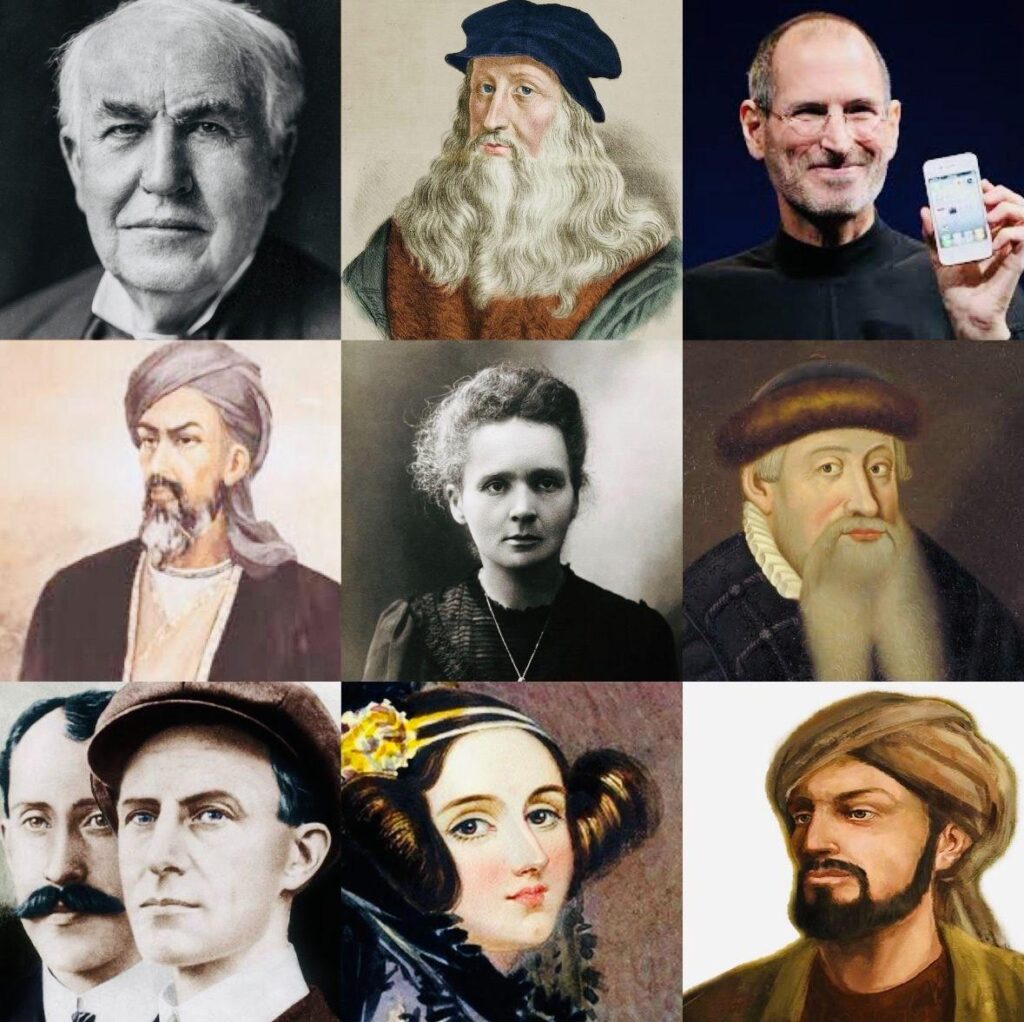
Rosalind Franklin produced the X-ray crystallography images that Watson and Crick used as direct evidence for the double helix structure of DNA. Image 51, the specific photograph that gave them what they needed, was shown to Watson without her knowledge or permission. She died in 1958 of ovarian cancer, possibly caused by radiation exposure from her research. The Nobel Prize for the DNA structure went to Watson, Crick, and Wilkins in 1962. Franklin wasn’t included. Nobel Prizes aren’t awarded posthumously, but the historical record of who contributed what took decades of active correction to properly reflect her role.
Hedy Lamarr was famous during her lifetime primarily as a film actress. She was also, during World War II, the co-developer of a frequency-hopping signal technology designed to make radio-guided torpedoes harder to detect and jam. A patent was filed in 1942. Military adoption never came during the war itself, and by the time the technology found real applications, the patent had already expired. Spread-spectrum communication principles built on her work are now foundational to modern wifi, GPS, and Bluetooth. Recognition arrived late in her life, in the 1990s, which is better than nothing but not by a wide margin.
Katherine Johnson calculated the orbital trajectories for the first American space flights, including John Glenn’s orbit and the Apollo 11 mission to the moon. Dorothy Vaughan led a computing section and became NASA’s first Black supervisor. Mary Jackson was NASA’s first Black female engineer. Their work was essential and their names were essentially unknown outside NASA for decades, until Margot Lee Shetterly’s book Hidden Figures and the subsequent film brought them to wide public attention in 2016. Johnson was awarded the Presidential Medal of Freedom in 2015. She was 97 years old.
The mark gets left whether or not the name survives with it. That’s the part that’s hard to sit with.
What the Pattern Actually Shows
Looking across all of these lives, the pattern that appears isn’t what the legend version suggests.
It’s not exceptional talent appearing fully formed and being recognized. It’s not destiny running on a predetermined track. What actually appears, consistently, is a specific set of decisions made mostly in private, mostly without external validation, often in the face of active resistance.
Keeping at the work when nobody is acknowledging it. Treating setbacks as information rather than final verdicts. Staying oriented toward something larger than personal comfort or recognition. These aren’t mystical qualities. They’re choices, made repeatedly, in ordinary moments that history doesn’t bother recording because they don’t photograph well.
The Books Worth Reading If This Actually Interests You
The most useful thing I can recommend, genuinely, is to read long, serious biographies rather than summaries or highlight reels.
Robert Caro’s series on Lyndon Johnson is four volumes and deeply unflattering in many places and one of the most instructive things I’ve read about how power actually works and what it costs. David Levering Lewis wrote two volumes on W.E.B. Du Bois that cover a life almost nobody knows well enough. Lauren Redniss wrote a biography of the Curies, Radioactive, that is both scientifically careful and genuinely moving. Edmund Morris wrote three volumes on Theodore Roosevelt that challenge nearly every simple version of that story.
These books are slow. That’s the point. The actual shape of a significant life takes time to render. The places where the person nearly gave up, the decisions that went wrong, the relationships that defined and sometimes damaged them — none of that compresses into a paragraph without losing the thing that makes it meaningful.
My history teacher’s question, what were they doing at thirty that nobody noticed yet, is actually the most useful question. Because the answer in almost every case is: the thing. Already. Quietly. Without any guarantee it was going to matter.
That’s not a comforting thing to know. There’s no promise attached to it. But it’s the accurate version, and the accurate version is the one that’s actually any use.