

Most People Never Learn About
Somebody at a dinner party told me the word algorithm comes from a person’s name. A ninth century mathematician named al-Khwarizmi, working in Baghdad. I nodded like I already knew this and then spent the next three days reading everything I could find because I absolutely did not know this and it bothered me that I did not.
That is usually how gaps in education reveal themselves. Not in classrooms. At dinner tables and in casual conversations where someone mentions something that should not be news to you but is.
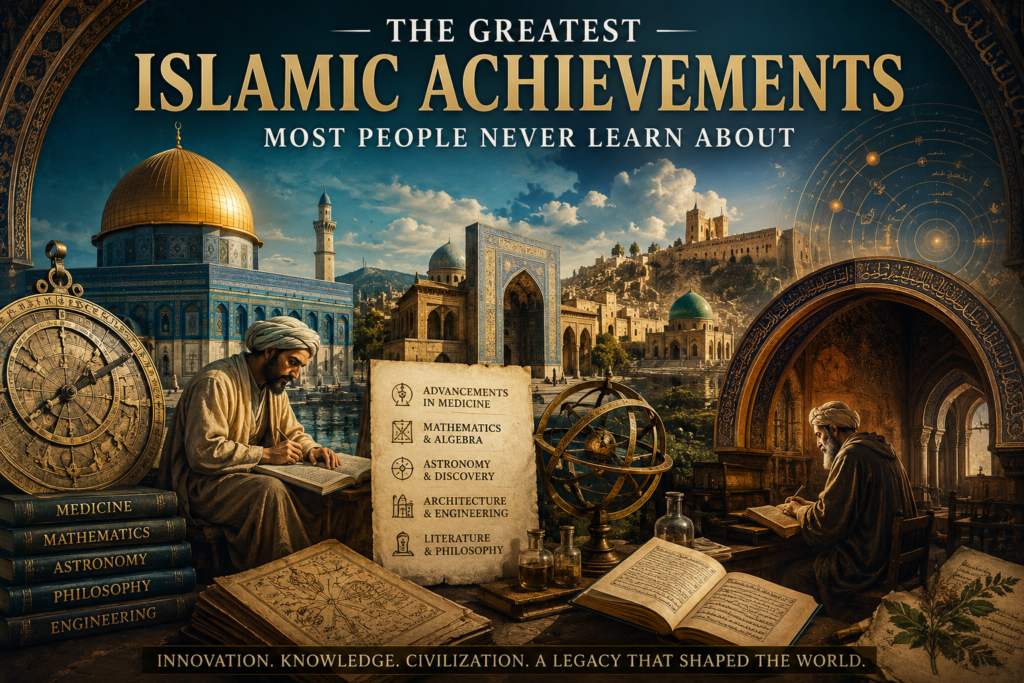
My schooling covered ancient Greece, Rome, medieval Europe, the Renaissance, the Enlightenment, two world wars, done. Somewhere in that sequence, several centuries of some of the most consequential intellectual work in human history got compressed into two paragraphs and a map showing trade routes. The Islamic Golden Age, roughly the eighth through the fourteenth centuries, produced advances in mathematics, medicine, optics, geography, engineering, astronomy, chemistry, and philosophy that the modern world is still directly using. Not as historical influence. As actual foundation.
Here is what those two paragraphs left out.
Al-Khwarizmi and the Invention That Made Computing Possible
The name al-Khwarizmi should be as recognizable as Newton or Einstein. It is not, at least not in most Western schools, which is strange given how directly his work affects daily life.
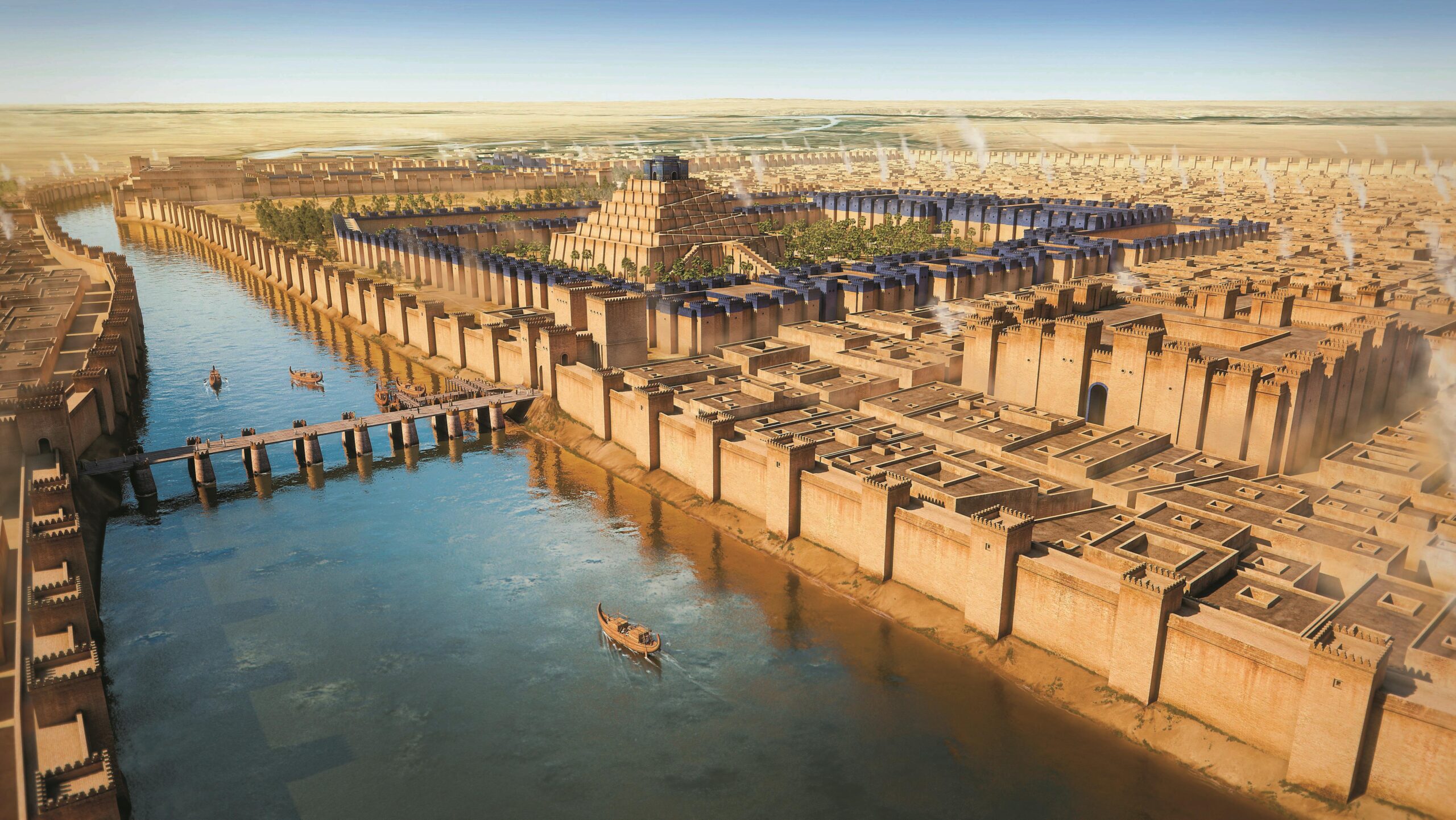
Working at the House of Wisdom in Baghdad in the early ninth century, al-Khwarizmi wrote a book whose Arabic title, when shortened and adopted into medieval Latin, gave the world the word algebra. The book was not written as abstract theory. Dividing estates according to Islamic inheritance law required reliable mathematical methods. Land surveys needed accurate calculation. Commercial disputes needed clear resolution. Al-Khwarizmi was solving practical administrative problems and in doing so created something with consequences far beyond administration.
The Latin version of his name produced the word algorithm. Every search result you have ever seen, every route a GPS has ever calculated, every product recommendation that has ever appeared on a screen: all of them run on algorithms. The conceptual move al-Khwarizmi made, shifting from working out specific problems to creating general procedures that work for any valid input, is the same conceptual move that makes software possible. A program is not an answer. It is a method for producing answers, which is exactly what al-Khwarizmi described in ninth century Baghdad.
Why This Specific Shift Was So Revolutionary
Before al-Khwarizmi, solving a mathematical problem meant either using geometric methods inherited from the Greeks, which were powerful but unwieldy, or working through specific numerical examples case by case. Neither approach generalizes easily.
What changed with algebra was that you could write a procedure that worked regardless of the specific numbers. Substitute any valid values and the method still works. That sounds obvious now because we absorbed this idea so thoroughly that it feels natural. In the ninth century it was a genuinely new way of thinking about problems. Every time a programmer writes a function that accepts any input rather than one specific value, they are using al-Khwarizmi’s fundamental insight without knowing his name.
What Islamic Hospitals Actually Were
Walk into any hospital built in the last two centuries and you will find things that seem basic: wards organized by condition, trained staff, patient records, treatments adjusted based on what is actually observed rather than what ancient texts say should happen. These feel like obvious features of a medical institution.
They were not obvious. They had to be invented somewhere.
The bimaristan, the Islamic hospital of the ninth century onward, had all of them. Separate wards for different conditions. Licensed medical staff who had passed examinations before being permitted to treat patients. Libraries. Pharmacies. Records kept on individual patients so that their treatment could be tracked and adjusted over time. The Baghdad bimaristan of 805 CE, built under the Abbasid caliph Harun al-Rashid, predates anything comparable in Europe by several centuries.
The Book That Ran European Medical Schools Until the 1600s
Ibn Sina completed his Canon of Medicine around 1025 CE. Five volumes. Over a million words. Covering general medical theory, simple drugs with documented properties and uses, diseases organized by which organ system they affected, systemic conditions, and compound medications.
European universities were still assigning it as a primary medical text in the seventeenth century. Not as historical reading. As current knowledge that practicing physicians needed to understand. A modern medical textbook becomes outdated within a decade because research moves fast. Ibn Sina’s Canon remained the standard reference for roughly six hundred years, which tells you something specific about how carefully it was put together and how much it got right.
The reason it lasted is not that medicine stopped advancing. It is that Ibn Sina built the Canon around clinical observation and systematic organization rather than around received authority. He evaluated conflicting sources and said clearly when evidence was insufficient. That approach produced a text that could be engaged with critically and updated at the margins rather than one that collapsed when any single claim turned out to be wrong.
Ibn al-Haytham and the Mistake That Stood for Centuries
Here is a belief that educated people held from ancient Greece through the early medieval period: your eyes emit rays that go out to objects and that is how you see them. Not light coming in. Rays going out. Euclid believed this. Ptolemy believed this. It was the mainstream position for over a thousand years.
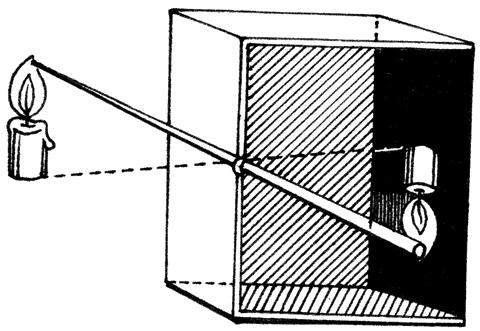
Ibn al-Haytham, working in Cairo in the early eleventh century, ran experiments that proved it wrong. Vision works because light from external sources enters the eye. His Book of Optics, finished around 1027 CE, laid out both the experimental evidence and the correct physical model of how light behaves. He described the camera obscura, explained why images appear inverted when projected through a small hole, and worked out the geometry of reflection and refraction with accuracy that held up under later scrutiny.
The part of his work that mattered as much as any specific finding was the method. Ibn al-Haytham did not argue from authority or from pure logic. He designed experiments, made observations, and accepted conclusions only when evidence supported them. That is what scientists now call the scientific method and it appears in the Book of Optics four centuries before Francis Bacon is typically credited with introducing it to Europe.
The Chain From Cairo to Modern Optics
Latin translations of the Book of Optics reached European universities in the thirteenth century. Roger Bacon, frequently cited as an early pioneer of experimental science in Europe, studied ibn al-Haytham’s work closely. Johannes Kepler’s breakthrough understanding of how the eye forms an image, published in 1604, built explicitly on foundations ibn al-Haytham had laid in the eleventh century.
Spectacles, telescopes, the camera obscura, the modern science of optics: follow any of these backward far enough and you arrive at Cairo in the early 1000s CE. That chain is documented and traceable. It is not the kind of influence that has to be inferred.
Al-Idrisi’s Map and the Knowledge Behind It
In 1154 CE a geographer named al-Idrisi completed a world map for the Norman king Roger II of Sicily. Roger was a Christian king who understood that the most sophisticated geographical knowledge available anywhere in the world at that time existed in the Islamic scholarly tradition, so he hired the best Islamic geographer he could find and gave him years to do the work properly.
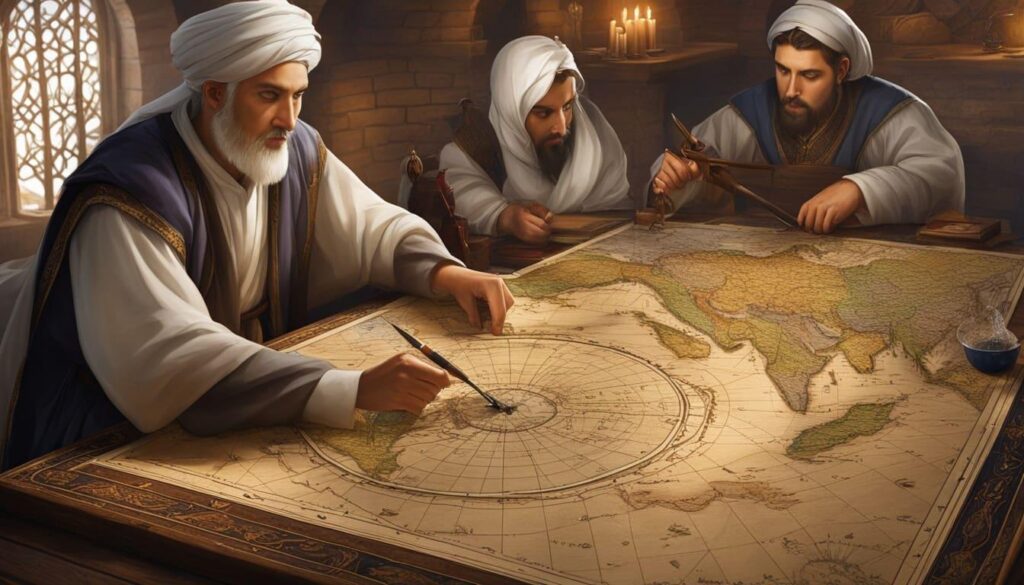
The resulting map remained the most accurate and detailed representation of the known world for the next three centuries. It covered Europe, North Africa, the Middle East, and large portions of Asia with a precision that had no equivalent elsewhere. Traders and travelers used it as a practical navigation reference.
What made Islamic geography so far ahead was a combination of sources available nowhere else. Ancient Greek texts. Persian imperial administrative records covering vast territories. Firsthand accounts accumulated from merchants and pilgrims moving along trade networks that stretched from Spain to Central Asia and from the Mediterranean to Sub-Saharan Africa. No other scholarly tradition had access to all of those simultaneously.
Ibn Battuta Walked Further Than Marco Polo and Almost Nobody Knows It
Ibn Battuta left Morocco in 1325 intending to perform the hajj and did not return for twenty-four years. His travels took him across North Africa, the Middle East, Central Asia, India, Southeast Asia, China, and Sub-Saharan Africa. Total distance traveled: an estimated 75,000 miles.
Marco Polo’s journey, which appears in most Western curricula, covered roughly 15,000 miles. Ibn Battuta covered five times that distance, documented a far wider range of societies, and produced a travel account called the Rihla that historians of fourteenth century Asia, Africa, and the Middle East still use as primary source material. Court customs in Mali, trading practices in the Maldives, political conditions in the Delhi Sultanate: the Rihla describes all of them in detail from direct observation.
The disproportion between how much space each traveler gets in standard Western curricula is instructive about how history gets selected rather than how history actually happened.
Al-Jazari’s Machines and What They Reveal About Medieval Engineering
Most people have a mental image of the medieval period as technologically static. Not in the Islamic world.
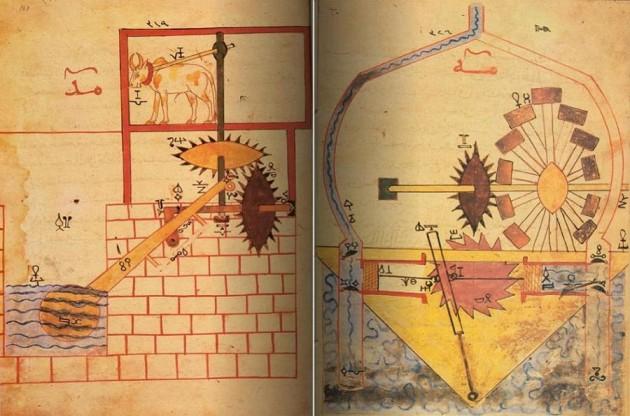
Al-Jazari served as chief engineer at the Artukid palace in what is now southeastern Turkey in the late twelfth and early thirteenth centuries. His Book of Knowledge of Ingenious Mechanical Devices described fifty machines in enough detail, with enough precision in the illustrations, that modern engineers working from those descriptions alone have built functioning versions of all of them.
Among those fifty machines: the crankshaft. The camshaft. A suction pump. Programmable automatic machines that performed sequences of actions without human intervention between steps. The first documented combination lock.
The crankshaft is worth pausing on. It converts reciprocating motion into continuous rotary motion, which is what allows a piston engine to turn a wheel. Every car engine, every motorcycle engine, every generator: all of them use a crankshaft. Al-Jazari described and illustrated one in the twelfth century. That is not a coincidence of parallel invention. European mechanical engineers encountered Islamic mechanical texts as they translated them, and those texts shaped what European engineers knew was possible.
Underground Water Engineering at Scales That Are Hard to Believe
The qanat system, networks of underground channels dug by hand to move water from mountain aquifers to lowland settlements, appears across the Islamic world at a scale that is genuinely difficult to visualize. Iran alone has over 270,000 kilometers of these underground channels. Individual qanats sometimes run for dozens of kilometers, maintaining precise gradients calculated so that water flows entirely by gravity with no pumping at any point.
Digging these tunnels required surveying with instruments accurate enough to maintain consistent gradients over long distances, all while working underground with medieval tools. The hydraulic engineering knowledge this represents was far beyond anything in contemporary Europe.
The Philosophy Handoff Most People Do Not Know Happened
When the Western Roman Empire collapsed in the fifth century, Greek literacy essentially vanished from Western Europe. The texts of Aristotle, Plato, Euclid, Galen, and Ptolemy existed but could not be read because nobody who worked with Latin could read Greek well enough to engage with them seriously.
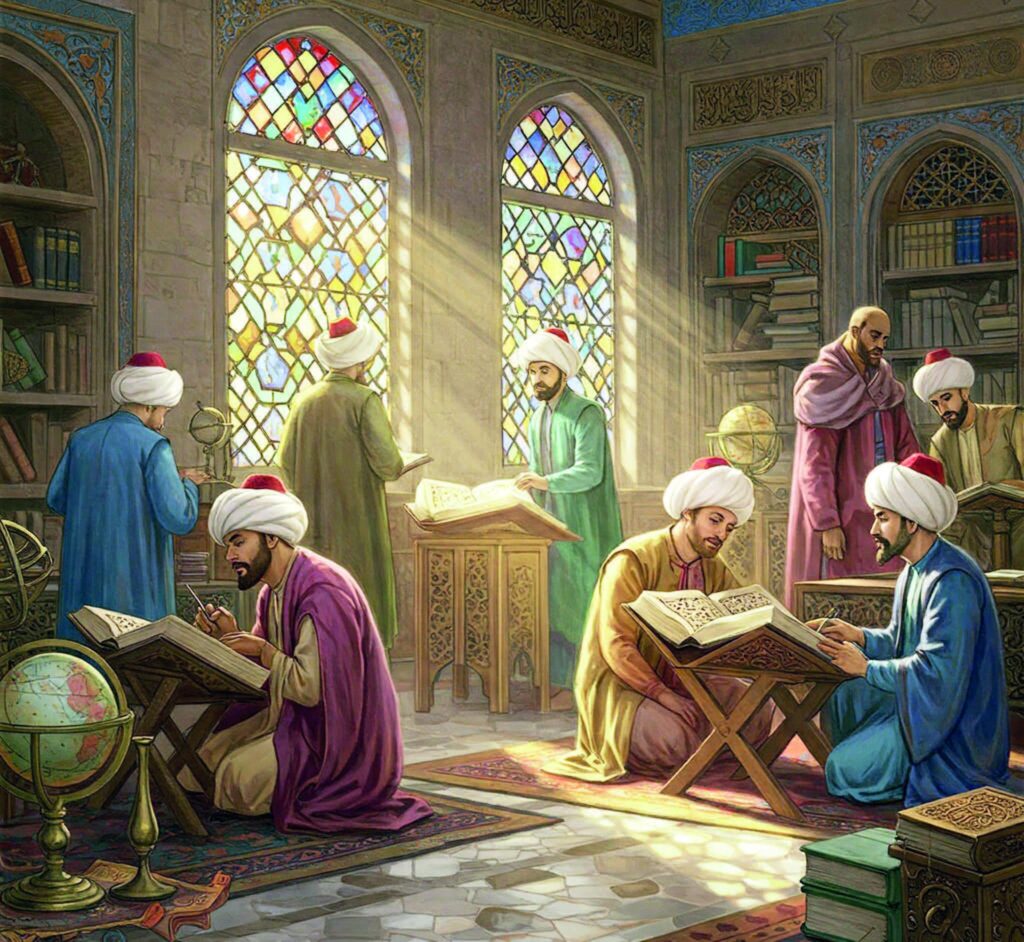
Islamic scholars began translating these texts into Arabic in the eighth century. Over several generations at institutions including the House of Wisdom in Baghdad, they not only preserved this knowledge but added commentaries, corrected errors, and extended the work significantly. The Greek texts that eventually transformed European intellectual life in the twelfth and thirteenth centuries reached Europe through Arabic translations made during this period.
How Averroes Made Aristotle Accessible to Christian Europe
Ibn Rushd, called Averroes in Europe, wrote commentaries on Aristotle so thorough and so carefully reasoned that European scholars referred to him simply as the Commentator, as though identifying him further was unnecessary. His work on Aristotle circulated widely in European universities from the twelfth century onward.
Thomas Aquinas, whose synthesis of Aristotelian philosophy and Christian theology shaped Catholic intellectual tradition for centuries, engaged directly with Ibn Rushd’s commentaries throughout his major works. The European Renaissance intellectual tradition traces part of its roots through Islamic scholarship. That is not a fringe historical interpretation. It is what the primary sources show.
Jabir ibn Hayyan and the Chemistry Vocabulary Still in Use
Jabir ibn Hayyan worked in the eighth century and is described in some sources as the father of chemistry. The description holds up better than most such honorary titles.
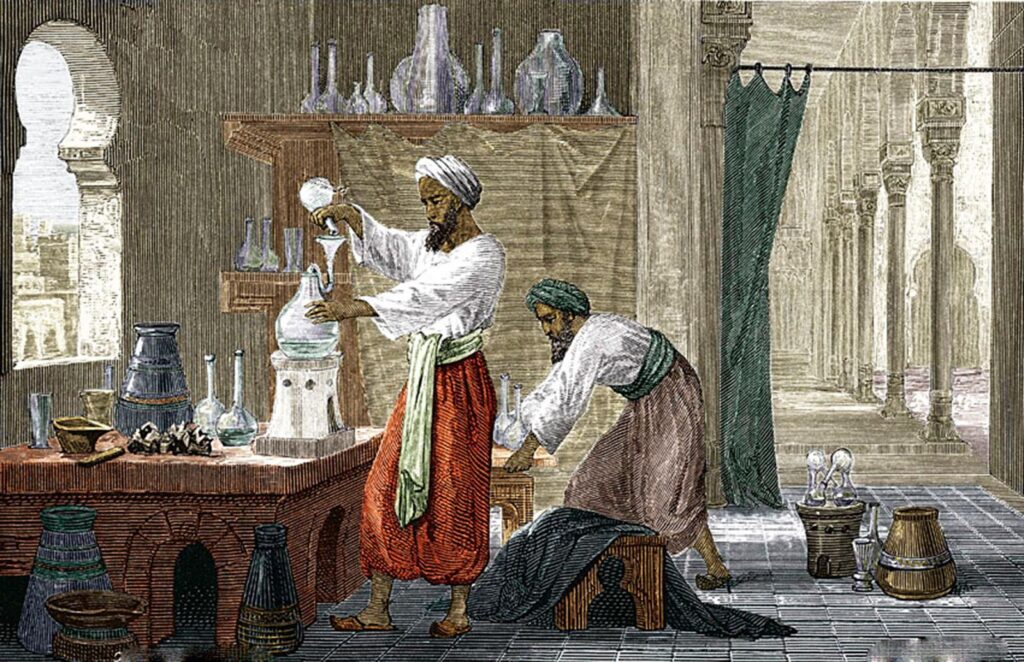
While alchemy elsewhere focused on transmutation and mystical processes, Jabir was running systematic experiments, writing down his methods precisely enough that they could be reproduced, and building practical chemical knowledge with real applications. Processes he documented for distillation, crystallization, sublimation, and calcination became standard techniques in later chemistry.
The vocabulary reveals the influence. Alcohol, alkali, alembic, amalgam, elixir, retort: all entered European scientific language through Arabic. You cannot work in a chemistry laboratory without using words that trace back to Islamic chemistry. The equipment you use carries names from that tradition. The methods underlying the equipment were developed there too.
Frequently Asked Questions
Why does this history not appear more in standard school curricula?
Curricula reflect the intellectual priorities and cultural context of the people who design them. Western schools historically emphasized Western history, which meant the Islamic Golden Age appeared mainly where it visibly intersected with European development. That framing is slowly changing as historians push for more genuinely global coverage, but it changes slowly because curricula change slowly.
Where can someone start learning about this without reading academic papers?
Jim al-Khalili’s book Pathfinders: The Golden Age of Arabic Science is the obvious first recommendation. Al-Khalili is a physicist at the University of Surrey and writes clearly for general readers. His BBC documentary series on Islamic science covers the same ground in a more visual format and is findable online without much searching. The MacTutor History of Mathematics archive at the University of St Andrews has detailed articles on Islamic mathematicians written for interested non-specialists rather than for academics.
Did Islamic scholars develop all of this independently?
No, and they would not have claimed otherwise. The translation movement that brought Greek texts into Arabic also pulled in Persian astronomical traditions, Indian mathematics including early work on zero and the decimal system, and Syrian Christian scholarly traditions. The Islamic Golden Age was a synthesis that drew on multiple civilizations, and the synthesis was itself the achievement. Taking what existed, evaluating it critically, extending it, and preserving it for later use required extraordinary institutional commitment over several centuries.
What is the most surprising single fact about Islamic scientific achievement?
Different people find different things surprising. For me it was the Ibn Sina medical textbook staying in use for six hundred years. For someone else it might be that the word algorithm is literally a Latin version of a mathematician’s name, or that most visible stars have Arabic names because Islamic astronomers catalogued them when European astronomy was not producing much new work. The deeper surprise, once you start pulling at any of these threads, is how many things you thought were European inventions turn out to have a longer backstory that runs through the Islamic world.
When that dinner party conversation about al-Khwarizmi sent me down a research rabbit hole, I expected to find interesting historical trivia. What I found instead was a consistent pattern: things the modern world depends on daily, whose origins I had never questioned, traced back to a time and place my education had covered in two paragraphs and a trade route map.
The gap is closeable. The information is not hidden. It just requires deciding to look, which is easier now than it has ever been, and worth the couple of hours it takes to start.