

Two bakeries opened on the same street in my neighborhood within six months of each other. Same general location. Same product category. Both run by people who clearly knew how to bake.
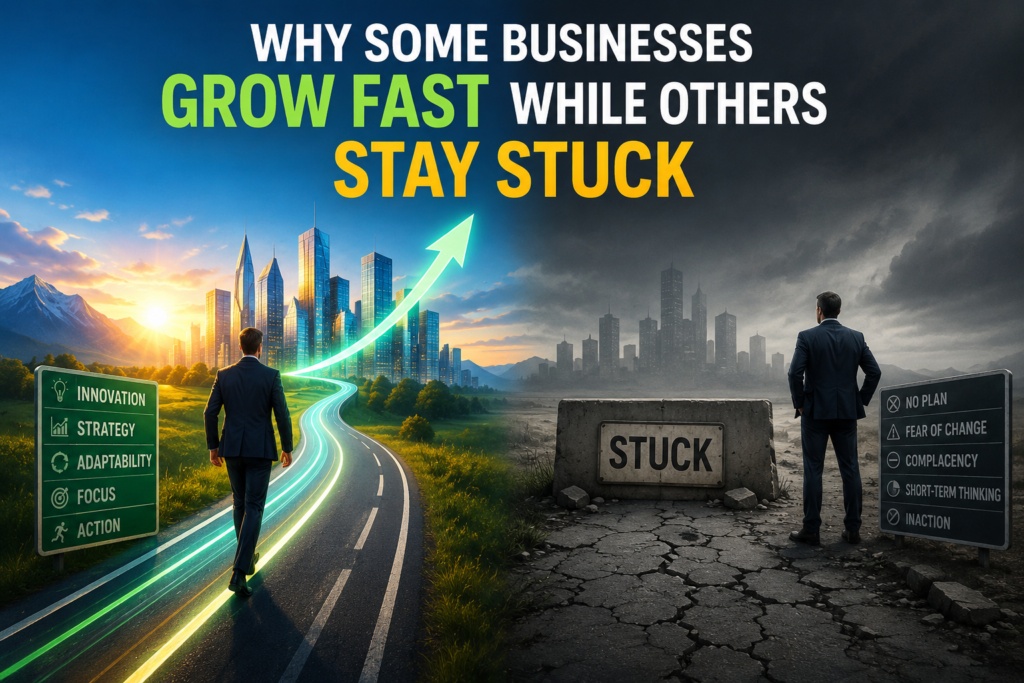
Three years later one of them has a line out the door on weekends, a second location across town, and a wholesale deal with two local cafes. The other one is still there, mostly quiet, running the same menu, serving the same small group of regulars it had in month two.
I got curious about this in the way you do when something does not make obvious sense. So I started paying attention. Both shops got regular orders from me. Conversations with the owners happened whenever the shops were quiet enough to allow it. Watching how each one handled a busy Saturday versus a slow Tuesday told me more than any single conversation did.
What I found was not what I expected. The difference had almost nothing to do with the quality of the baking. Both made genuinely good product. The gap came from somewhere else entirely, and once I saw it I started noticing the same pattern in businesses across completely different industries.
This is what separates the ones that grow from the ones that stay exactly where they started.
The First Thing Fast-Growing Businesses Do Differently
The bakery with the line outside made one decision early that the other one did not. They picked a specific customer and built everything around that person.
Not everyone who likes baked goods. A specific person: the weekday morning commuter who wants something good but fast, the weekend family that treats a bakery visit as an event, the office manager who needs a dozen items for a team meeting and wants reliable quality without having to think too hard about it.
Every menu decision, every pricing call, every piece of signage, every social media post came back to those specific people. The shop knew exactly who it was talking to and exactly what that person needed from them.
The other bakery tried to be everything. Gluten free options, vegan options, celebration cakes, lunch sandwiches, coffee, seasonal specials rotating every few weeks. The menu was long. The identity was blurry. Walking in felt like the shop was still figuring out what it wanted to be.
Why Trying to Reach Everyone Reaches Nobody
This pattern shows up constantly across industries and it surprises people every time because the logic of casting a wide net feels right. More potential customers should mean more actual customers.
What happens instead is that broad positioning produces weak signal. When your business stands for something specific, the right people find you faster, trust you quicker, and tell other people about you more naturally because they can describe you in one sentence. When your business stands for everything, nobody knows how to describe you and word of mouth, which is still the most powerful growth engine for most small businesses, stalls out.
The fastest growing businesses I have watched, across restaurants, service businesses, product companies, and agencies, all share this quality of clarity. They know exactly who they serve and they say no to everyone outside that definition without apparent anxiety about it.
Systems Are What Separate Growth From Chaos
The second major difference I noticed had nothing to do with the product or the customer selection. It was about what happened when things got busy.
The growing bakery handled a Saturday morning rush with four people working in obvious choreography. Each person had a role. The line moved. Orders came out correctly. The owner was present but not doing everything personally.

At the other bakery, a busy period produced visible stress. The owner was simultaneously taking orders, making coffee, packaging items, and answering questions about the menu. When two people came in at once it created a bottleneck. The quality of the interaction dropped. Sometimes items ran out because nobody had tracked inventory properly.
One business had built systems. The other was still running entirely on the founder’s personal effort and attention.
What a Business System Actually Means in Practice
Systems sound like corporate language but the reality is simple. A system is just a documented repeatable process for doing something so that the outcome does not depend on any single person’s memory or presence.
For the bakery it looked like: a prep checklist run every morning before opening, a clear station assignment for each staff member during rush periods, a weekly inventory count that triggered restocking before items ran out rather than after, and a standard way of handling custom orders that did not require the owner to personally manage every conversation.
None of that is complicated. Writing it down and training people on it is the work. Most small business owners skip this because they are too busy doing the work to document the work, which is exactly the trap that keeps them personally essential to every single thing that happens.
If the business cannot function when you take a day off, you do not have a business yet. You have a job that follows you home.
Tools that help here: Notion works well for documenting processes in a way that is easy to update and share. Trello and Asana handle task tracking when multiple people are involved. Even a shared Google Doc with clear checklists beats keeping everything in one person’s head.
The Revenue Model Question Most Stuck Businesses Never Ask
Here is a question worth sitting with: does your business make money while you sleep, or only while you work?

Most stuck businesses fall into the second category. Revenue appears when the owner shows up and stops when the owner does not. Every dollar earned requires a direct trade of personal time.
Fast-growing businesses almost always find ways to create some version of income that does not require that direct one-to-one exchange of time for money. Not necessarily passive income in the fantasy sense. Just revenue streams with better leverage.
The growing bakery added a wholesale account with two local cafes. They make the same product they were already making, in larger batches, delivered twice a week. The margin per unit is lower than retail but the volume more than compensates and the revenue arrives predictably without requiring any customer-facing effort.
They also started a simple subscription: a weekly bread box delivered locally, charged monthly through Square, which gave them predictable revenue they could plan production around rather than guessing what each week would look like.
Neither of these required a major business reinvention. Both came from looking at what they already did well and asking how to make it available in a form that did not depend entirely on foot traffic.
Spotting the Leverage Opportunities in Your Own Business
The questions worth asking are practical. What do you make or do that could be batched more efficiently? Which customers would pay for reliability and consistency through a subscription or retainer rather than buying one-off? What knowledge do you have that could be packaged into something that sells without your direct involvement?
Not every business has obvious answers to all of these. Most businesses have at least one if you look honestly. The stuck ones tend to not ask the question at all because the current model is working well enough to survive, which turns out to be the enemy of working well enough to grow.
How Fast-Growing Businesses Think About Marketing Differently
The stuck bakery ran occasional Instagram posts. Some of them were good photos. None of them had any particular strategy behind them. Posting felt like an obligation rather than a deliberate activity with a specific goal.
The growing bakery treated their Instagram account as a direct line to the exact customers they had identified as their target. Every post was either showing the product in a way that made the right person want to come in, demonstrating the process in a way that built trust, or sharing something about the people behind the business in a way that created connection.
Posting happened consistently. Not obsessively, three or four times a week. But consistently enough that people who followed them actually remembered the bakery when they wanted what it sold.
Email collection started from day one through a simple tablet at the counter with a sign that said “get our weekly specials.” That list became genuinely valuable because it let them communicate directly with people who had already chosen to hear from them, without depending on an algorithm to decide who saw their content.
The Marketing Mistake That Keeps Businesses Stuck
Trying every platform simultaneously and doing none of them well is the most common marketing error I see in stuck businesses. Facebook, Instagram, TikTok, Google Ads, email, local flyers, all running at low effort and low consistency simultaneously.
The growing businesses I have paid attention to almost always do fewer things with more focus. Picking one or two channels where their specific customers actually spend time and committing seriously beats spreading thin across everything by a wide margin.
Local businesses tend to do best on Instagram or Facebook depending on the customer age range, combined with email. Service businesses usually find more traction on LinkedIn plus a simple email sequence. Product businesses might lean toward TikTok plus a focused paid ad strategy on one platform rather than half-efforts on five.
The tool matters less than the consistency and the clarity of who you are talking to. Mailchimp handles email marketing reliably for most small businesses at a reasonable price point. Later and Buffer both schedule social posts in advance, which removes the daily decision fatigue of figuring out what to post right now.
The People Problem Nobody Wants to Talk About Honestly
Every business that stays stuck has a version of the same people problem. Either the owner cannot let go of control enough to let other people do things, or the people they have hired are not the right people for where the business needs to go.
Sometimes both.
The stuck bakery owner did everything personally because she genuinely believed nobody else would do it right. She was probably correct that nobody else would do it exactly the way she did it. What she missed was that her standard of exactly right was actually preventing growth rather than protecting quality.
Delegation does not mean accepting lower quality. Done properly it means defining what quality looks like clearly enough that someone else can meet that standard reliably. The work of writing clear standards and training people to them feels like overhead. It is actually the investment that allows the business to grow beyond the owner’s personal capacity.
Hiring Before You Feel Ready and Why Waiting Costs More
Most small business owners wait to hire until they are so overwhelmed that the hire becomes urgent. Urgent hiring produces bad hiring. When you need someone immediately you make compromises on fit that cost far more over the following months than the salary does.
The growing bakery hired their second employee when they were at about seventy percent capacity, not when they were at one hundred and ten percent and drowning. That gave them time to train properly, to discover what they needed to adjust in their processes, and to make a considered decision about whether the fit was right before they were desperate.
If you track your time honestly for two weeks and find you are consistently doing work that someone else could be trained to do for less than your own time is worth, you are past the point where you should have hired.
The calculation is simple even if the emotional part is not. If you spend twenty hours a week on tasks that could be done by someone earning fifteen dollars an hour, that is three hundred dollars of work that is consuming time you could use to grow the business instead.
What Stuck Businesses Do With Feedback Versus What Growing Ones Do
This one is subtle but it matters more than people expect.
Stuck businesses treat negative feedback defensively. A bad review produces an explanation of why the customer was wrong or what unusual circumstances caused the problem. Critical feedback from employees or advisors gets absorbed politely and then mostly ignored.
Fast-growing businesses treat feedback as data. A pattern of similar complaints is a signal worth investigating rather than a threat to defend against. A customer who bothered to say something negative is giving information that the silent customers who simply stopped coming never provided.
How the Growing Bakery Turned Reviews Into a Growth Engine
The growing bakery owner told me she reads every review, responds to every complaint with a genuine resolution, and has a notebook where she tracks recurring themes. When three people in one month mentioned that the line moved slowly, she spent a week watching her own process and made two changes that cut average wait time significantly. The reviews improved without her asking anyone to leave better reviews.
That feedback loop, from customer experience to operational change to improved experience, is one of the most reliable growth engines available to any small business and most owners do not build it deliberately at all.
The Mindset Gap That Everything Else Comes Back To
After watching both of these bakeries for three years and having enough conversations with the owners to understand how they each think, the deepest difference is not strategic. It is about what each owner believes is possible and what they believe their role is.

The stuck bakery owner sees herself as a baker who runs a shop. Her identity is in the craft and the daily operation. Growth would mean changing what she does every day and she is not sure she wants that, which is actually a legitimate and honest position even if she does not quite frame it that way to herself.
The growing bakery owner sees herself as someone building a business that happens to bake things. She is attached to the outcome and the customer experience rather than to personally doing every task. Adding a second location does not feel like losing something. It feels like the point.
Neither of these is morally superior. But only one of them produces a business that grows.
Working Out Which One You Actually Are
This question is more useful than any tactical advice: do you want a business that grows, or do you want to do the work you love at a scale that feels manageable?
Both are valid answers. The problem comes from wanting the results of the first while operating with the mindset of the second. That combination produces frustration on both ends. The business does not grow because the owner keeps making choices that prioritize their own comfort and control. The owner does not feel satisfied because they are trying to build something bigger than their current approach allows.
Getting honest about which one you actually want clears up a lot of confusion about why the business is where it is. It also points directly to which specific things need to change if growth is genuinely the goal.
Frequently Asked Questions
Why do some small businesses grow quickly while others with similar products stay small?
The gap almost always comes down to three things: clarity about who the customer is, systems that allow the business to operate without depending entirely on the owner, and a willingness to invest in growth before it feels completely safe to do so. Product quality matters but it rarely explains the difference between businesses at similar quality levels.
How do I know if my business has a systems problem versus a marketing problem?
If revenue comes in but operations feel chaotic and you cannot take time off without things breaking, it is a systems problem. If operations run smoothly but new customers are not finding you, it is a marketing problem. Most stuck businesses have some of both but one tends to be more urgent than the other.
Is it possible to grow a business without hiring anyone?
Up to a point, yes. Automation and leverage through digital products, subscriptions, or wholesale relationships can extend what one person can manage. Beyond a certain revenue level, though, growth almost always requires other people. The businesses that try to scale without hiring typically hit a ceiling and stay there.
What is the single most important thing a stuck business can do right now?
Pick one specific customer, describe them in detail, and make every decision for the next ninety days through the lens of whether it serves that person better. Clarity about the customer fixes more downstream problems than almost any other single change.
Both bakeries are still there. Each owner seems reasonably happy with where they are, which tells you something worth remembering. Growth is not the only measure of a good business. It is just the one that requires specific choices and a specific kind of thinking.
If growth is what you want, those choices are available. Most of them are not complicated. The hard part is making them consistently when staying exactly where you are feels comfortable enough.
That comfortable enough is where most businesses live permanently. It does not have to be where yours does.