
I’ll never forget sweating through my shirt outside the Cairo Museum. I stared at a golden death mask made before most modern languages even existed. Our tour guide mentioned something casually. The pyramids were already ancient history to the Romans. That one line smashed my brain a little.
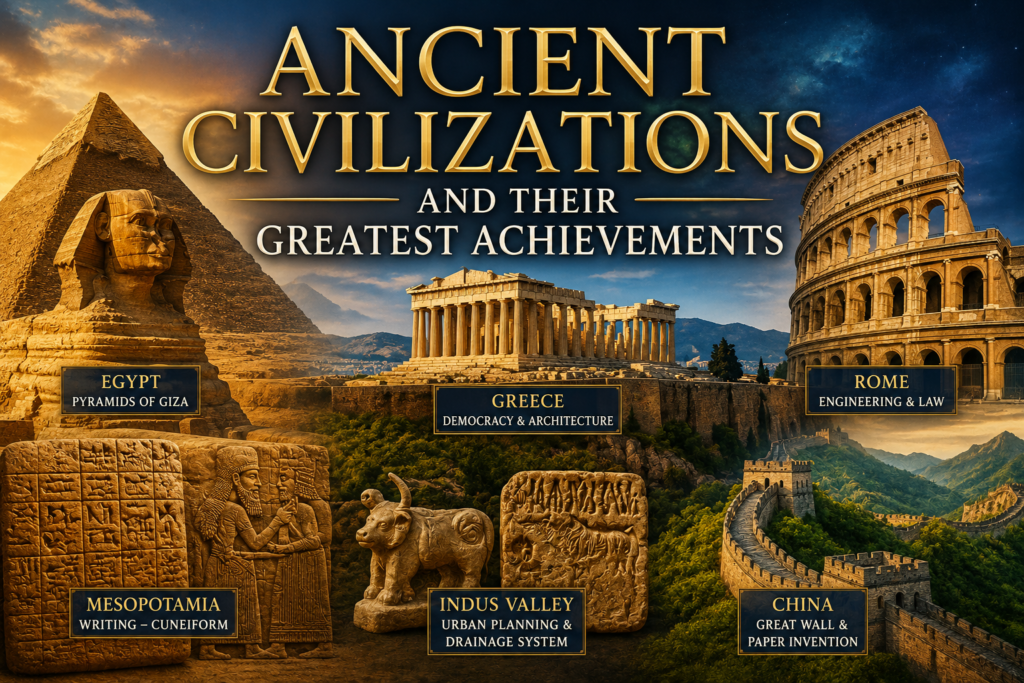
I grew up treating “ancient” as one blurry category. It isn’t. Some of these civilizations sit as far apart in time from each other as they do from us.
That trip changed how I read history. I stopped picturing ancient civilizations as dusty textbook chapters. I started picturing them as engineering firms, city planning departments, and research labs that just happened to exist thousands of years ago. Once you view them that way, the achievements stop feeling like trivia. They start feeling genuinely impressive.
This article pulls together years of reading, a few trips to historical sites, and way too many documentaries watched late at night. No fluff, no textbook tone. Just the stuff that made me think, “wait, they did what?”
Why This Topic Grabbed Me in the First Place
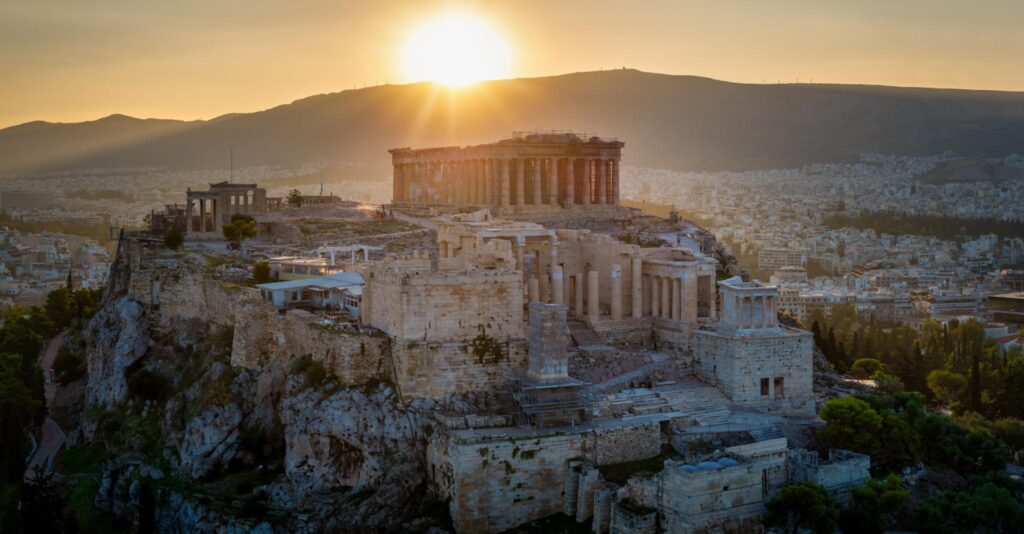
I didn’t plan to get obsessed with ancient history. It happened by accident during a layover in Athens. I had six hours to kill, so I skipped the airport lounge and took a cab to the Acropolis instead.
Walking up to the Parthenon, I noticed something odd. The columns aren’t perfectly straight. They bulge slightly in the middle. Architects call this trick entasis, and it makes the building look straighter from a distance. Ancient Greek builders understood optical illusions well enough to correct for them, all without modern measuring tools.
That’s when it hit me. These weren’t primitive people fumbling around with rocks. They were problem solvers working with limited resources and serious patience.
Egypt: Engineering That Still Confuses Modern Builders
Let’s start with the obvious pick, since most people picture a pyramid first when they think of ancient history.
Builders finished the Great Pyramid of Giza around 2560 BCE for Pharaoh Khufu. It held the title of tallest man-made structure on the planet for roughly 3,800 years. Nothing beat its height until builders completed Lincoln Cathedral in medieval England.
Here’s what genuinely surprised me once I dug into the construction methods. Workers weren’t slaves dragged in chains, despite what pop culture often suggests. Archaeologists found worker villages near the pyramids with bakeries, medical facilities, and signs of decent nutrition. These were paid laborers, likely farmers who worked during the Nile flood season when their fields sat underwater anyway.
The Precision Problem
The base of the Great Pyramid stays level to within about two centimeters across a 230-meter square. Modern construction crews with laser levels sometimes struggle to match that accuracy.
Historians believe the Egyptians used water channels to check for level ground. Water always finds a flat surface, so the trick worked without any fancy tools. Simple idea, brilliant execution.
Beyond the Pyramids
People often forget Egypt’s other contributions:
- A 365-day calendar, remarkably close to what we still use today
- Early surgical instruments and medical texts like the Edwin Smith Papyrus
- Hieroglyphic writing that recorded everything from tax records to love poems
- Massive irrigation systems that turned desert land into farmland
I once read a translated Egyptian medical text. The instructions for treating a broken nose shocked me. Splint it. Keep it still. Wait. A modern doctor would tell you nearly the same thing.
Mesopotamia: The Place Where Writing Was Born
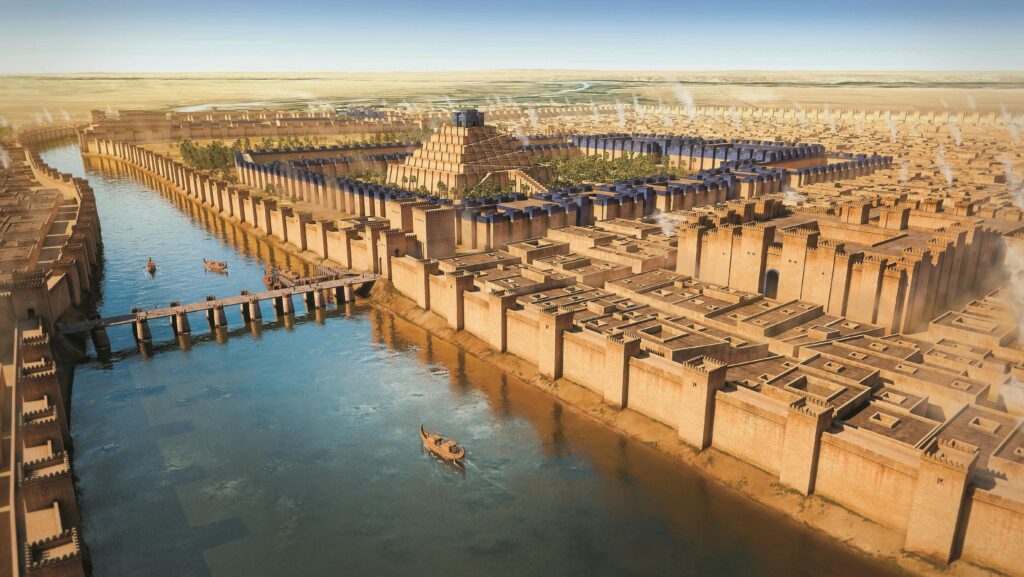
Everyone knows Egypt. Mesopotamia doesn’t get enough credit. This region, tucked between the Tigris and Euphrates rivers in modern-day Iraq, gave humanity its first true writing system.
Cuneiform started around 3200 BCE as a way to track grain shipments and tax payments. It sounds practical and boring, but it changed everything. Once people could write things down, they no longer had to rely on memory alone to pass knowledge across generations.
Hammurabi’s Code
People often sum up King Hammurabi’s law code as “an eye for an eye.” The actual document, written around 1754 BCE, goes far deeper than that phrase suggests. It covered property disputes, wages for laborers, and even malpractice rules for doctors.
I noticed something while reading translated excerpts. The laws punished people differently based on social class, which feels unfair by today’s standards. Still, a written legal system beat rule by whoever held the most power that day.
Ziggurats and City Planning
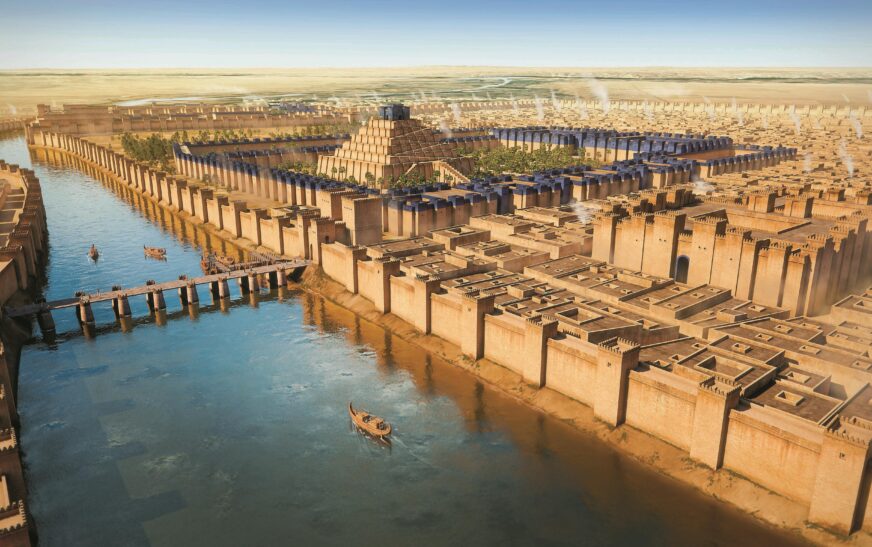
The Mesopotamians built massive stepped temples called ziggurats. Cities like Ur and Babylon had organized streets, drainage systems, and marketplaces. If Babylon’s Hanging Gardens truly existed as described, engineers needed an irrigation system that pumped water uphill nonstop. That’s no small feat for the Bronze Age.
Indus Valley: The Civilization Ahead of Its Time
This civilization surprised me the most. I never learned much about it in school.
The Indus Valley Civilization spread across parts of modern Pakistan and northwest India. Builders raised cities like Mohenjo-daro and Harappa around 2500 BCE. A giant monument didn’t blow my mind here. The sewage system did.
Homes had private bathrooms connected to covered drains running under the streets. This was a functioning citywide sewage network, and it predates ancient Rome by thousands of years. Most European cities didn’t figure out that dumping waste in the street causes disease until much later.
Standardized Everything
Builders across different Indus Valley cities made bricks to nearly identical ratios and sizes. Weights and measures stayed consistent across a huge geographic area. That level of standardization points to centralized planning, or at least widely shared building standards. That’s impressive for a civilization whose written language we still can’t read.
Nobody has cracked the Indus script yet. Every few years, someone announces a breakthrough. Every few years, it turns out inconclusive. This remains one of history’s most frustrating unsolved puzzles.
Ancient Greece: Ideas That Outlasted the Buildings
People bring up Greece constantly, usually connected to democracy or philosophy. They have good reason to.
Athens developed a system where citizens voted directly on laws and decisions. They skipped elected representatives entirely. The system only applied to free adult men, which limited citizenship by modern standards. Still, the core idea felt new: ordinary people got a real say in governance.
Philosophy You Can Still Apply Today
I read a translated version of Marcus Aurelius’s personal journal a few years back. I expected something dry and academic. I got the opposite. It read like private notes on stress, ego, and mortality. Stoic philosophy from Greek thinkers like Zeno still shows up in modern self-help books, business podcasts, and therapy sessions. Most people never realize where the ideas started.
Architecture and Math
Greek architects developed golden ratio principles that designers still use in software like Adobe Illustrator and Canva. Pythagoras and Euclid built mathematical foundations that every engineering student still learns, whether they use AutoCAD or just a pencil and graph paper.
Divers recovered the Antikythera mechanism from a shipwreck. It turned out to be an analog computer built to predict astronomical positions and eclipses. Scientists used X-ray imaging in the 2000s and found gear systems so complex that nothing similar appeared again until medieval European clockwork, over a thousand years later.
Rome: The Civilization That Built to Last
Rome doesn’t need much introduction, but the specifics still catch people off guard.
Roads and Concrete
Roman engineers built roads with multiple layers, including a drainage layer. Many original sections remain walkable today. Some modern European highways still follow the exact routes Romans laid out two thousand years ago.
Roman builders mixed volcanic ash into their concrete. Researchers at MIT studied samples from ancient piers a few years ago. They found that seawater exposure actually strengthened the material over time instead of weakening it. Modern concrete typically breaks down under similar conditions within decades. Scientists now want to reverse-engineer the Roman formula for coastal construction.
Aqueducts and Public Health
Roman aqueducts moved water across huge distances using gravity alone. No pumps involved. Rome had public baths, public toilets, and a sewage system called the Cloaca Maxima that ran continuously for centuries.
I visited a preserved Roman bathhouse in Bath, England. The heating system underneath the floor, called a hypocaust, worked much like the radiant floor heating systems people install today. The core idea barely changed in two thousand years.
China: Inventions Hiding in Plain Sight
Chinese achievements weave so tightly into daily modern life that people forget where they came from.
Ancient China gave the world paper, gunpowder, the compass, and printing, all well before similar technologies appeared elsewhere. Builders started the Great Wall around the 7th century BCE and rebuilt it across multiple dynasties. It now stretches over 13,000 miles when you count all branches and sections.
The Terracotta Army
Emperor Qin Shi Huang commissioned more than 8,000 life-sized clay soldiers to guard his tomb. Archaeologists still haven’t fully excavated the main burial mound. They worry about preservation and safety. Each soldier has distinct facial features, which suggests individual craftsmanship rather than mass production from a single mold.
Silk Road Trade Networks
The Silk Road wasn’t one single road. It was a network of trade routes connecting China to the Mediterranean. Merchants moved goods along it, but the routes also carried ideas, religions, and technology across continents long before anyone imagined globalization.
The Maya and Aztec: Astronomy Without Telescopes
General history discussions overlook Mesoamerican civilizations far too often. That’s a shame given what they accomplished.
The Maya developed a calendar system so precise that their solar year calculations beat the European calendar in use at the same time. They tracked Venus closely enough to predict its movements centuries in advance, all without telescopes or mechanical instruments.
Builders designed Chichen Itza’s main pyramid, El Castillo, with a specific trick in mind. During the spring and fall equinox, the setting sun creates a shadow pattern that looks like a serpent slithering down the staircase. I watched a video of this once. It looked eerily intentional, all achieved through pure architectural math.
The Aztecs built their capital city, Tenochtitlan, on an island in a lake. Causeways connected it to the mainland, and floating agricultural plots called chinampas fed the population. Spanish conquistadors arrived in the 1500s and compared the city’s scale and cleanliness favorably to European capitals of the time.
Common Mistakes People Make When Learning About Ancient Civilizations
I’ve noticed a few patterns after years of reading and a handful of trips.
People assume “ancient” means “primitive.” Many of these societies had complex governments, working plumbing, and legal systems while parts of the world still lived in scattered settlements.
People treat all civilizations as if they existed at the same time. The pyramids were already over a thousand years old when Cleopatra ruled Egypt. Most people lump everything “ancient” into one mental bucket.
People trust pop culture over actual research. Movies love dramatic slave labor scenes and mystical explanations for engineering feats. Real archaeology usually points to organized labor, clever tools, and a lot of trial and error.
People skip the lesser-known civilizations. Everyone knows Egypt and Rome. Few people study the Indus Valley, ancient Nubia, or the Olmec civilization, despite their equally impressive contributions.
People ignore the human side of history. Regular people with families and bad days at work built every monument. Reading personal letters or worker records humanizes the past far more than staring at ruins alone.
How to Explore This Topic Yourself
If any of this sparked your curiosity, here’s how I’d suggest diving in without getting overwhelmed.
Step one: start with a documentary series. Try the BBC’s “Civilisations” or a well-reviewed YouTube channel. It gives you context before you jump into denser reading.
Step two: try an app before a textbook. Google Arts & Culture offers free virtual tours of museums like the British Museum and the Egyptian Museum. It includes zoomable, high-resolution artifact photos. You’ll spot details you’d miss even in person.
Step three: listen to a history podcast during your commute. “The Ancients” and “Fall of Civilizations” both explain complex topics in a conversational format without dumbing things down.
Step four: read one accessible book instead of five academic ones. Try “Sapiens” by Yuval Noah Harari or “1177 B.C.” by Eric Cline. Both give a readable overview without requiring a history degree.
Step five: visit a local museum, even a small one. You don’t need to fly to Egypt. Regional museums often hold surprisingly good ancient artifact collections, and seeing a real object in person hits differently than a photo does.
Step six: book skip-the-line tickets in advance if you travel. Sites like the Colosseum or the Pyramids of Giza get brutally crowded. Apps like GetYourGuide or official ticketing pages save you hours of standing in line.
Step seven: keep a simple notes app open while you explore. I use Notion to jot down random facts and questions as I read, then look them up later. This turns passive reading into active learning.
A Few Real Examples From My Own Reading List
I made a mistake early on. I jumped straight into dense academic papers about Mesopotamian trade routes. I gave up after two pages.
Something narrower worked much better. I started with the story of the Rosetta Stone, and how it let scholars finally decode Egyptian hieroglyphics in the 1820s. One focused story pulled me naturally into broader Egyptian history, instead of forcing me through a textbook’s chronological order.
Here’s another example. A short video on aqueducts made me curious about Roman engineering. That led me to the Pont du Gard in France. That led me to Roman concrete. Eventually, I found that MIT study I mentioned earlier. Curiosity chains work far better than forced study schedules.
Final Thoughts
A few things stick with me most from years of poking around this topic. Not the size of the pyramids. Not the length of the Great Wall.
I realized that people thousands of years ago solved the exact same problems we still deal with today. How do you move water where it needs to go? How do you keep a growing city from drowning in its own waste? How do you build something that outlasts you?
They didn’t have our tools, but they had time, patience, and a willingness to test ideas until something worked. Some of their solutions still hold up better than things we build today. That’s a strange kind of humbling.
Take the chance if you ever get to stand in front of one of these structures in person. Photos and documentaries work fine, but standing next to a wall built before your language existed feels different. It puts your own timeline into perspective, and honestly, that beats any history class I ever sat through.