


My first business lost money for eleven months straight. Not dramatically, not catastrophically, just quietly and consistently. Every month I would look at the numbers, tell myself next month would be different, and then next month would arrive and look exactly the same.
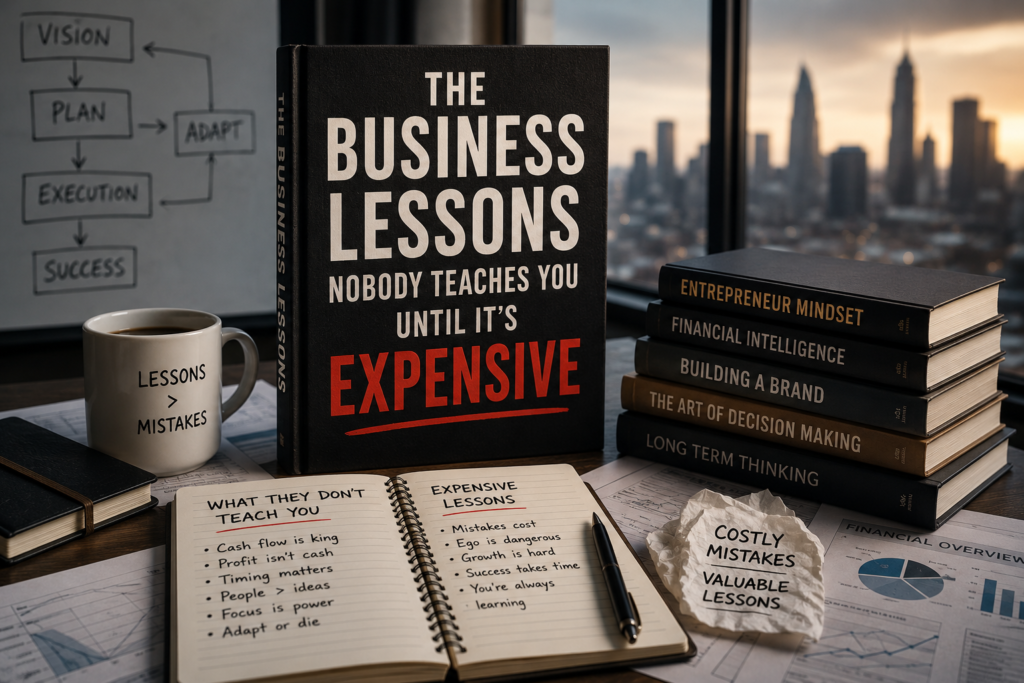
The business eventually turned around. But the lessons that saved it were not the ones I learned from any course, book, or mentor session. They were the ones I learned after paying for the mistake first.
Nobody warns you about most of this stuff. Business books talk about vision and hustle and disruption. They skip the part where you hire the wrong person and spend four months untangling the damage. They skip the part where a client owes you three months of invoices and suddenly stops responding. They skip the part where you realize you built something that only works if you personally work eighty hours a week inside it.
This is the stuff they skip. And most of it cost me real money before I figured it out.
Revenue Is Not the Same Thing as Profit and Confusing Them Is Catastrophic
The first year my agency crossed six figures in revenue, I genuinely felt like I had made it. Six figures. That sounded serious. That sounded like a real business.
What I had not done was look at what was left after paying contractors, software, taxes, and the time I spent managing everything. What was left was not six figures. It was closer to what I had been making at my previous job, except now I was working longer hours with more stress and zero benefits.
Revenue is the number on the top line. Profit is what you actually take home. Gross profit is what remains after direct costs. Net profit is what remains after everything. These are not the same number and treating them as interchangeable is one of the most common and expensive mistakes early business owners make.
Why This Mistake Keeps Happening
The reason it happens is that revenue is the number everyone celebrates. Clients and contracts feel like wins. Invoices going out feel like progress. But invoices going out and money actually arriving in your account after all expenses are covered are two very different things.
Getting clear on your actual margin per product or service changes every decision you make. Some of the clients I was proudest of landing were actually costing me money once I calculated the real time involved. Dropping them and replacing them with better-fit clients was one of the best moves I made, and I only figured that out because I forced myself to sit down and calculate actual margins instead of looking at the top line.
QuickBooks and Wave both make this reasonably straightforward to track. The work is not technical. The work is making yourself look at the real numbers instead of the ones that feel good.
Verbal Agreements Are Worth Exactly Nothing
A friend of mine runs a small construction business. A few years back, a longtime client asked him to start a large project based on a handshake and a promise that the contract was coming. The contract never came. The project finished. The client disputed the price, claimed the scope had always been different from what my friend understood it to be, and the whole thing ended with my friend absorbing a significant loss because there was nothing in writing to stand behind.
This story is not unusual. Versions of it happen constantly across every industry.
The lesson is not complicated. Everything goes in writing before work starts. Scope, price, timeline, payment terms, what happens if scope changes, what happens if payment is late. All of it, documented, signed by both parties, before a single hour of work gets done.
Setting Up Contracts Without a Lawyer on Retainer
You do not need to spend thousands on a lawyer to have basic contracts. Platforms like HelloSign, DocuSign, and PandaDoc let you send and collect signatures digitally. For contract templates, Bonsai has solid service agreement templates built specifically for freelancers and small agencies. A one-time consultation with a contract lawyer to review your standard agreement costs far less than a single disputed client situation.
The mindset shift that matters here is understanding that contracts protect both parties. A client who pushes back hard on signing a basic agreement before work starts is showing you something important about how they operate. That resistance is information worth having before you commit your time.
Cash Flow Problems Kill Businesses That Are Actually Profitable
This one took me the longest to fully understand because it feels paradoxical. A business can be profitable on paper and still run out of cash. It happens more than people realize, and it is one of the most common reasons small businesses close.

Here is how it works in practice. You land three big clients in January. You do the work in February and March. You invoice in March. Your payment terms are net thirty, meaning clients have thirty days to pay. Some of them pay late. So cash from that February and March work arrives in April or May, or not at all if a client ghosts. Meanwhile you have expenses in February, March, April, and May that do not wait for your clients to pay. Payroll does not care about your accounts receivable. Software subscriptions do not pause while you chase invoices. Rent is due on the first regardless.
Making Cash Flow Predictable Instead of Terrifying
A few things actually help here. Shorter payment terms are the first lever. Net thirty became net fifteen for most of my clients. Some of my contracts moved to fifty percent upfront before work starts and fifty percent on completion. Retainer arrangements, where clients pay a fixed monthly amount for ongoing work, smooth out the unpredictability significantly.
Chasing invoices manually is exhausting. FreshBooks and HoneyBook both have automated payment reminder sequences that follow up with clients without you having to write another awkward email. Setting those up saves time and removes the emotional weight of chasing money.
Keeping a cash reserve equal to at least two months of operating expenses changes how the business feels to run. Building that reserve takes time but the mental clarity it creates is worth the discipline required to get there.
Hiring Too Fast Is How You Burn Through Money
The moment a business starts making real money, the temptation to hire is enormous. More people means more capacity means more revenue, the logic goes. What that logic skips is that more people also means more management, more complexity, more fixed costs, and more things that can go wrong simultaneously.
My worst hiring decision was bringing on a full-time employee to handle something I should have first tested with a contractor. The role was not well-defined enough. The person I hired was not wrong for the job in some abstract sense. The job was not right for the stage the business was at. Six months later I was paying a salary for work that was not moving the business forward, and ending that situation cost time, stress, and money I had not budgeted for.
The Better Sequence for Bringing People In
Start with contractors for new functions. This lets you test whether the work actually needs to be done full-time, whether your systems are developed enough to support someone else doing the work, and whether the specific person is the right fit before committing to a permanent arrangement.
Document processes before hiring anyone. If you cannot explain how you want something done clearly enough to write it down, you cannot hand it off effectively. The discipline of writing down how you do things before someone else needs to do them saves enormous amounts of time and money in onboarding and corrections.
Be honest about whether you are hiring for growth or hiring to avoid doing something you dislike. Both can be valid, but they require different approaches and different types of people.
Pricing From Confidence Instead of Fear
Most new business owners price too low. Not slightly too low. Dramatically too low. And the reason is almost never strategic. The reason is fear that higher prices will scare clients away.
Here is what nobody tells you about that fear. Clients who push hardest on price at the start tend to be the most difficult to work with throughout the engagement. Clients who accept a fair price without extensive negotiation tend to respect your work and your time more consistently. The correlation is not perfect but it is real enough to matter.
How Underpricing Actually Makes Problems Worse
Pricing too low creates a specific trap. Low prices attract high volume of the wrong clients. Serving those clients at low margins leaves no time to find and develop better clients. The business grows in size but not in quality or profitability. Raising prices later feels risky because the entire client base was attracted by low prices.
Getting out of that trap requires either gradually raising rates with existing clients while simultaneously attracting better clients at higher rates, or making a more abrupt shift that involves losing some existing clients intentionally. Both paths are uncomfortable. Neither is as uncomfortable as staying stuck.
Research what competitors charge. Talk to people in adjacent businesses about what the market actually bears. Price based on the value you deliver rather than the hours you spend. An hour of your expertise after ten years of building that expertise is not worth the same as an hour of a beginner. Charging as if it is the same is not humility. It is just inaccurate.
The Wrong Clients Cost More Than No Clients
Turning down work when you need revenue feels impossible. But some clients cost more than they pay, and figuring out which ones those are before committing is a skill worth developing deliberately.

Red flags that took me too long to learn to spot: extensive scope negotiations before signing, late responses during the sales process, requests for discounts framed as compliments about your work, unrealistic timelines presented as non-negotiable, and vague project descriptions where the client cannot clearly explain what success looks like.
None of these individually is necessarily disqualifying. All of them together is a pattern worth taking seriously.
Building a Client Filter That Actually Works
Creating a simple intake process helps significantly. A short questionnaire before a discovery call filters out people who are not serious or not a fit without requiring you to spend an hour on the phone first. Questions about timeline, budget range, and what they have already tried reveal a lot about how they approach working with vendors.
Referrals from existing good clients are almost always better fits than cold inquiries. Building a business where current clients refer new clients is not an accident. It happens when you do good work and make it easy for people to refer you by being specific about who your ideal client actually is.
Taxes Will Surprise You If You Let Them
The first year I owed self-employment taxes on top of income taxes I was not prepared for the number. Nobody had explicitly explained to me that as a business owner I would be paying both the employee and employer portions of certain taxes, that quarterly estimated payments were expected, and that the penalty for not making those payments was real.
Setting aside a percentage of every payment received specifically for taxes, before it touches anything else, is the only approach that reliably works. The percentage varies based on your situation but twenty-five to thirty percent of net profit is a reasonable starting point for most small business owners to set aside until they have worked with an accountant to get a more precise number.
Finding Tax Help That Is Actually Worth the Cost
A good accountant pays for themselves many times over. Not just through tax savings but through the confidence of knowing you are not accidentally making expensive mistakes. Bench handles bookkeeping for small businesses at a reasonable price point. A CPA who works specifically with small businesses is different from a general tax preparer and worth the difference in fee.
QuickBooks Self-Employed automatically tracks mileage and separates business from personal expenses, which makes tax time significantly less painful and ensures you are not leaving deductions unclaimed.
Protect Your Business From Yourself
This one is harder to talk about but genuinely important. A business that only functions when you are fully present and fully engaged is not a business. It is a job with extra paperwork and no guaranteed paycheck.

Burnout is not a character flaw or a sign of weakness. Running too hot for too long is a structural problem with how the business operates, not a personal failing. If your business stops when you take a week off, if every client problem eventually lands on your desk regardless of who else is theoretically handling it, if you cannot genuinely disconnect without things breaking, that is a systems problem.
Building Something That Can Run Without You Being Everywhere
Standard operating procedures for every repeated task are the foundation. When a process only exists in your head, it leaves with you when you are out. Written processes can be followed, trained to, and improved by someone else.
Systems like Notion or ClickUp make documenting processes accessible without requiring technical knowledge. The initial investment of time to write these things down is real. The return on that investment shows up every time something runs correctly without your direct involvement.
Delegation is a skill that most founders underestimate. Giving someone a task and giving someone ownership of an outcome are different things. Learning to hand over outcomes rather than just tasks changes what becomes possible in terms of building something that does not require your constant presence to function.
Relationships Matter More Than Tactics
Every significant business opportunity that came my way in the past five years has come through a relationship. Not through ads, not through cold outreach, not through content marketing, though all of those have their place. The actual big moves came through people who knew me, trusted the quality of my work, and either hired me directly or referred me to someone who did.

This sounds obvious but most people operationalize it poorly. They show up at networking events and collect business cards. They connect on LinkedIn and immediately send pitches. They treat relationships as funnels rather than as actual human connections with people whose success they genuinely care about.
What Building Real Business Relationships Actually Looks Like
Giving before asking is the operating principle that actually works. Referring business to someone else first. Sharing genuinely useful information without asking for anything in return. Celebrating other people’s wins publicly. Making introductions between people who should know each other.
None of this is manipulation. It is just being useful to people you respect, which is how relationships work outside of business too. The business benefit is a byproduct of actually giving a damn about the people in your professional world, not a result of performing care while actually just extracting value.
Keep a running list of people you want to stay in contact with and schedule actual touchpoints. Not automated emails. Real messages that reference something specific about them or their work. Fifteen minutes a week maintaining relationships returns more than most marketing activities I have ever tried.
The Learning Never Stops But It Does Get Cheaper
None of these lessons are secrets. Most of them exist somewhere in business books, podcasts, and courses. The reason they still cost people money is that reading about something and having it cost you personally are different experiences that produce different kinds of knowledge.
The practical shortcut, if there is one, is finding people who are a few years ahead of you in a similar type of business and asking them directly what they wish they had known earlier. Most people are willing to share if you ask genuinely and show that you will actually use the answer.
Business forums like Reddit’s r/Entrepreneur and r/smallbusiness have uneven quality but genuine signal if you filter carefully. Mastermind groups, formal and informal, with peers at similar stages are often more valuable than courses because the knowledge is specific to your actual situation rather than hypothetical.
Every expensive lesson listed above was also a lesson someone ahead of me already knew. Some of them told me. Some of them I did not listen to carefully enough because I thought my situation was different. It was not different. It was just my turn to pay for it.
The goal from here is making sure it is not also your turn.